
Overview
This is a private commission for an Indian family living in a large suburban London house with a medium-sized garden. The clients wished to become more self-sufficient and make productive use of their garden space. At their request, certain personal details remain private, though they are happy for the design itself to be shared as an example — particularly for the Asian community they hoped to inspire.
I was initially reticent about taking on private work (preferring community projects), but the clients made a compelling case and proved to be excellent and enthusiastic collaborators.
Methodology
A custom methodology developed specifically for forest garden design, working through layers systematically: Collect info → Evaluate → Map → Canopy → Understory → Water → Paths → Nutrients → Shrubs → Guilds → Implement → Manage. This layered approach ensures each element is placed with full awareness of its relationship to every other layer.
Working Through the Design
-
1
Initial Meeting & Proposal
I visited the site for an initial evening meeting, conducted a basic interview, and surveyed the space. The clients were open to all suggestions; their main wish was for as much food diversity as possible, including unusual or valuable plants that could save money or be used for exchange. They wanted to keep an existing green chair and were enthusiastic about the idea of greywater treatment and a pond.

The proposal sent to the client the following day -
2
Collect — Site Survey
Client Wants
The client brief was refreshingly open: as much food as possible; unusual or expensive plants; herbs, medicines, fruits, green leaves, roots and salads; a pond and greywater system; keeping the existing magnolia tree and the neighbour's overhanging apple.
Base Maps
The clients provided rough hand-drawn maps which I verified on site and then modelled accurately in Google Sketchup.
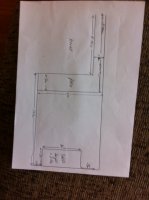
Client's hand-drawn map (1) 
Client's hand-drawn map (2) 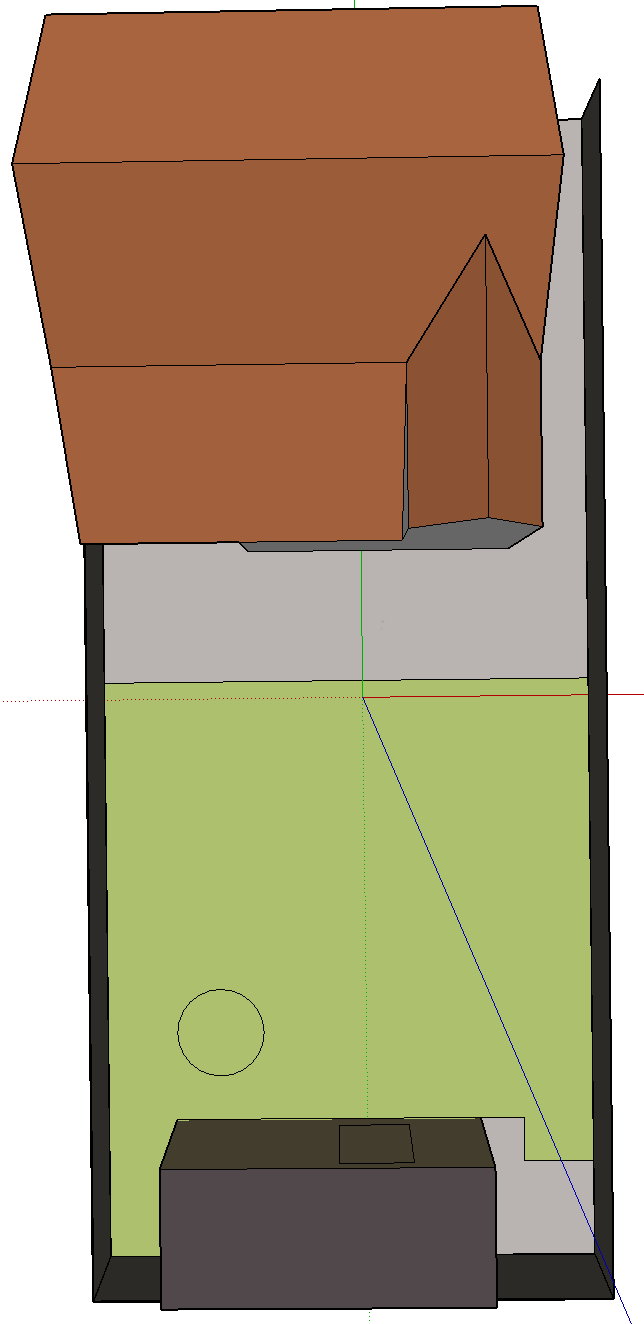
Verified Sketchup basemap Soil Sample
Soil was sampled across the site and tested. The soil is silty clay — it needs organic matter to improve structure and drainage — with a reasonable pH.

Sample locations map 
Soil sample Wind Statistics

Annual wind summary 
January 
June 
December -
3
Evaluate — Zones, Sun & Soil Assessment
The site is very sunny throughout, apart from directly in front of the shed. The silty clay soil needs organic matter additions. Zones were mapped to identify planting intensity areas.

Basemap 
Zone 1 
Zone 2 
Zone 4 -
4
Design — Canopy, Understory & Structures
Working from the canopy downwards, trees and understory plants were placed on the map, then structures were added. A key design feature is a central seated area, around which a half-hugel (raised mound bed) curves on each side — creating an intimate, productive social space at the heart of the garden.
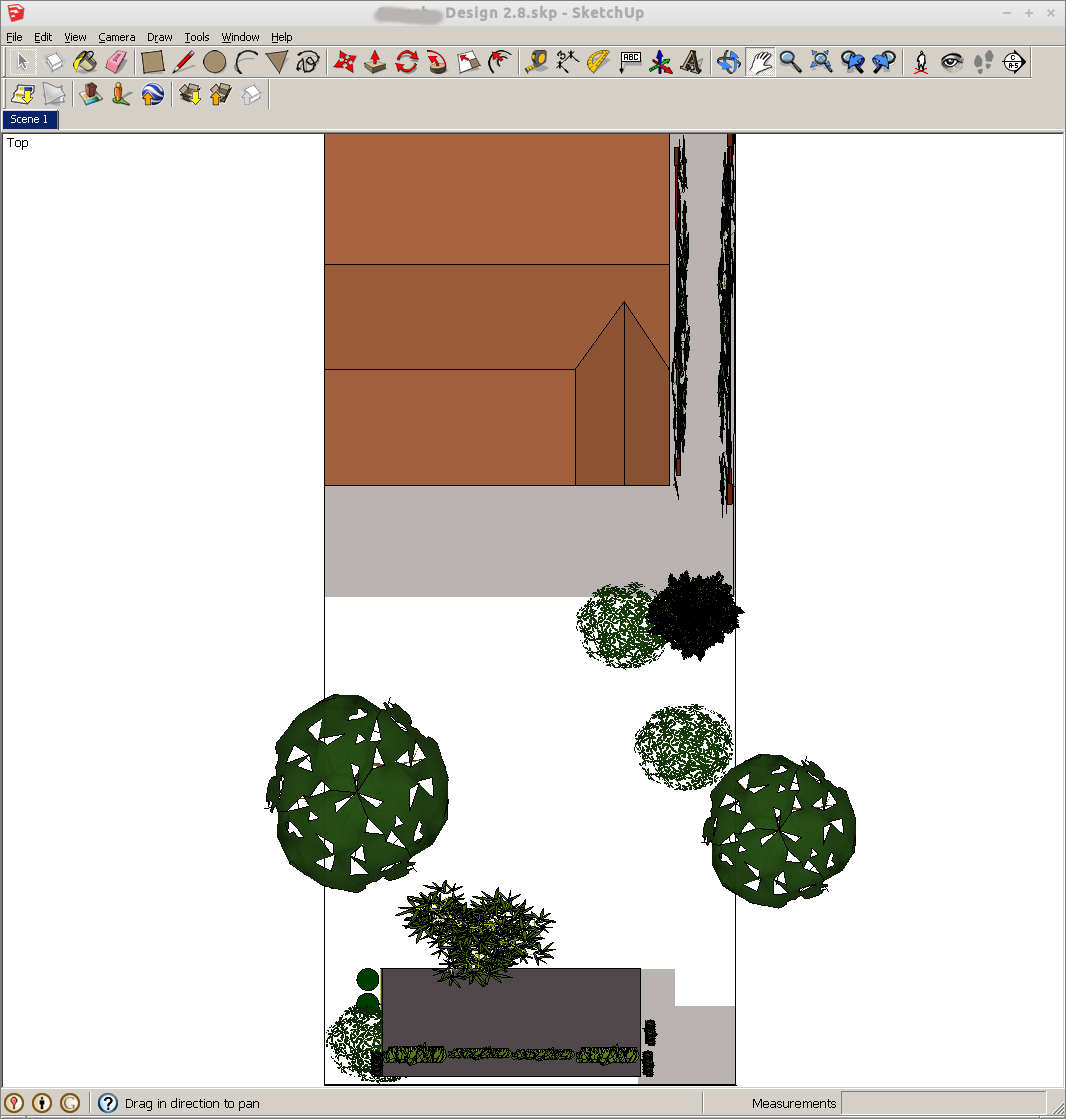
Canopy and understory planting plan 
Structures added — including the central seating area with hugel mounds -
5
Water — Greywater System
The garden's water supply comes from shower greywater. Rather than redesign a greywater system from scratch, I adapted an existing pattern I had already developed and refined the detail for this site's specific conditions.

Water system overview 
Greywater system detail 🌿 Design PatternReusing an existing, proven greywater pattern is itself good permaculture practice — use and value diversity and apply self-regulation and accept feedback. Refining a working pattern is more efficient than reinventing from scratch. -
6
Paths, Hugelkultur & Nutrients
Paths were designed to give access to all planting areas while keeping compaction to a minimum. Hugelkultur mounds were incorporated to improve soil structure and water retention. A nutrient calculation was carried out to determine fertility requirements as the system establishes.

Paths and hugelkultur design 
Nutrient calculation — determining fertility strategy -
7
Sections & Guilds
The garden was divided into sections, each with a designed guild incorporating herbaceous plants, climbers, creepers and root-layer plants around and beneath the trees.
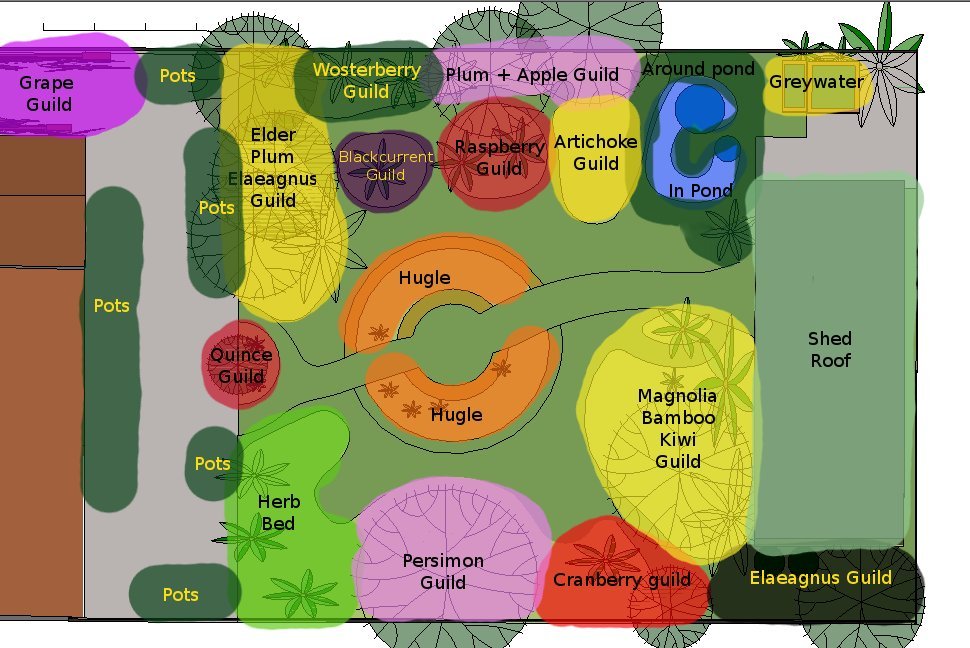
Sections and guild planting plan -
8
Implementation
Implementation took place over multiple visits. The photographs below document the transformation from a conventional garden into a layered forest garden.
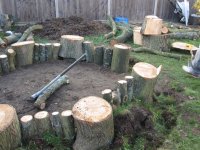
Early works 
Planting 
Hugel mounds 
Establishing 
Growing 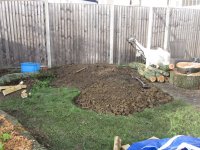
Progress
Reflections & Outcomes
This commission demonstrates how a forest garden approach can work beautifully in a conventional suburban setting. An open client brief, combined with a systematic layered design methodology, produced a design rich in diversity — herbs, fruits, unusual edibles, medicines, and wildlife habitat — within a manageable, attractive garden.